






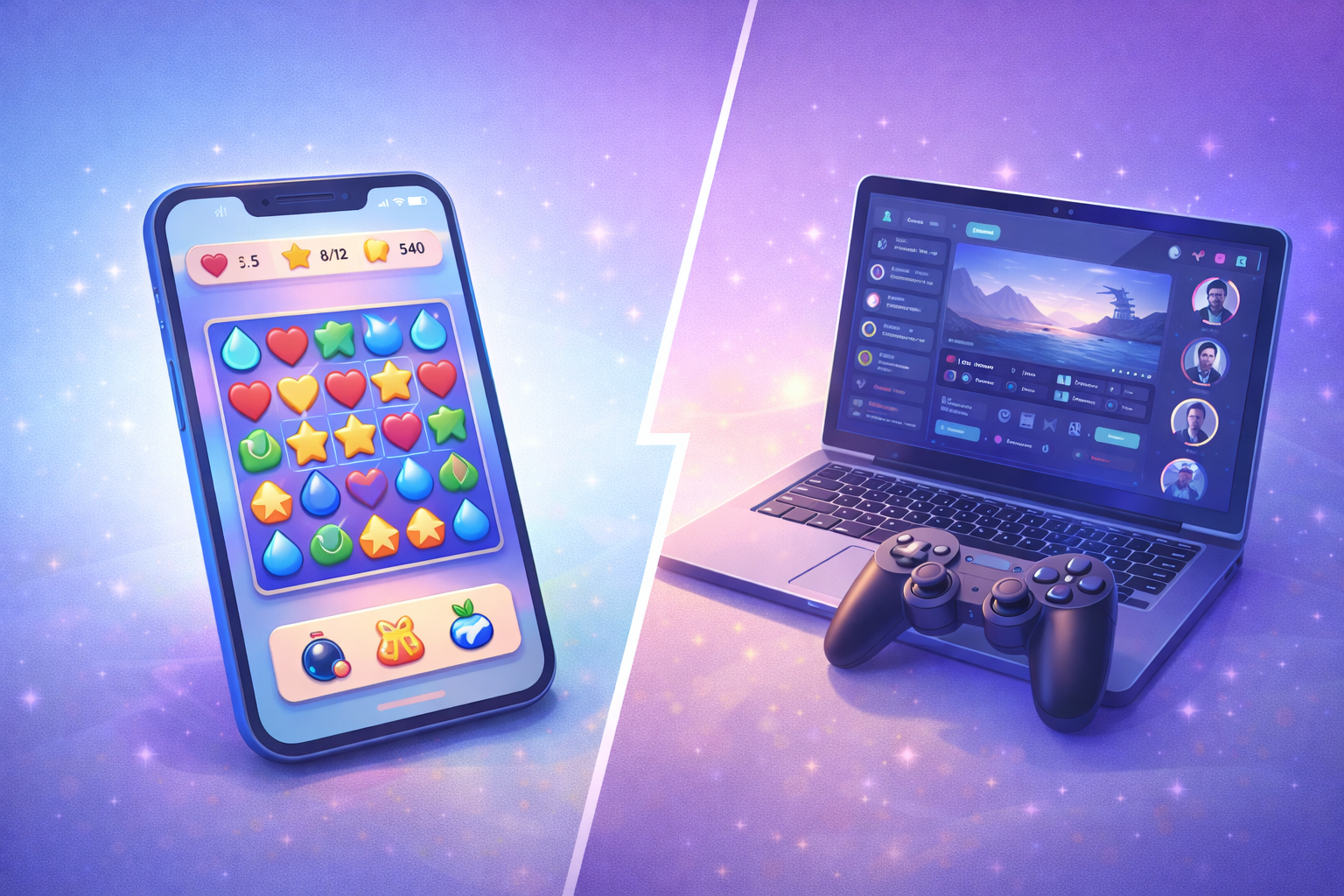

People often compare mobile games and online games as if they’re opposites. But they’re not.
-
Mobile games describe where you play (on a phone/tablet).
-
Online games describe how you play (over the internet/network).
That means a game can be:
-
Mobile + Online (e.g., multiplayer mobile games)
-
Mobile + Offline (no internet needed)
-
PC/Console + Online
-
PC/Console + Offline
So the real question isn’t “mobile vs online” as a strict matchup. The practical comparison is usually:
-
Mobile gaming (often quick sessions, touch controls, portability, app-store discovery, heavy free-to-play)
vs -
Online-first gaming (multiplayer focus, accounts, live updates, servers, competitive play, community features), which can happen on mobile, PC, console, or browser.
This guide breaks everything down clearly so you can decide what’s actually better for you.
Quick definitions
What is a mobile game?
A mobile game is a video game played on a mobile device (smartphone/tablet/handheld), and it can be played with or without network availability depending on the game.
What is an online game?
An online game is a game played partly or primarily over the internet or a computer network. It can be on PC, console, or mobile.
What is a browser game (often confused with “online game”)?
A browser game runs inside a web browser often requires internet, but not always (some can be cached). Usually no installation needed.
The main reason people compare “mobile vs online”
Because modern gaming trends overlap:
-
Mobile gaming is huge globally (often the largest segment by revenue).
-
Online features (multiplayer, seasons, live events, cloud saves, updates) are now common across platforms.
So what users really want to know is:
-
What’s different in experience?
-
What’s better for fun, competition, cost, and convenience?
Mobile vs Online Games: The real differences that matter
1) Device & control style
Mobile games
-
Touch controls (tap, swipe, drag)
-
Optional: controllers, gyroscope, haptics
-
Great for quick play, less great for high-precision competitive input (unless optimized well)
Online games (platform-agnostic)
-
Inputs depend on platform:
-
PC: keyboard/mouse (high precision)
-
Console: controller (consistent, competitive)
-
Mobile: touch/controller hybrid
-
Bottom line: If your game requires precision aim + fast reaction, input method matters as much as being “online.”
2) Session length and “life fit”
Mobile
-
Designed for short bursts: 2–10 minutes
-
Easy to start/stop
-
Built around commuting, breaks, waiting time
Online-first games
-
Often designed around longer sessions
-
Multiplayer matches, raids, ranked ladders, events
-
More commitment and scheduling with friends/teams
Simple rule:
If you want gaming that fits into life, mobile wins.
If you want gaming as a hobby with depth, online-first ecosystems shine.
3) Internet dependency and stability
Mobile games
-
Many are playable offline (especially puzzle/solo)
-
Online features often “optional” (ads, cloud save, events)
Online games
-
Server connection is essential for core play
-
If servers go down, the game may become unplayable
Why latency matters (especially online multiplayer)
Latency affects responsiveness, how quickly your action reaches the server and returns.
A practical benchmark example: Lenovo suggests low latency and gives general ranges such as aiming for below ~50ms for competitive experiences.
Key takeaway: Online games are only as good as your connection.
4) Graphics & performance
Mobile
-
Modern phones are powerful, but still:
-
Smaller thermal limits
-
Battery constraints
-
Variable performance based on device age
-
-
Games often optimized for broad compatibility
Online games (especially PC/console online)
-
Higher ceiling:
-
Better sustained performance
-
Higher refresh rates
-
More stable frame pacing
-
-
But also higher hardware cost
5) Monetization & business model (biggest day-to-day difference)
This is where the “feel” of mobile vs online can diverge the most.
Common mobile models
-
Free-to-play + ads
-
Free-to-play + in-app purchases
-
Battle pass / season pass
-
Gacha/loot-style mechanics (varies by game)
Common online-first models
-
Premium purchase (buy once)
-
Subscription (some genres)
-
Cosmetic microtransactions
-
Battle pass + cosmetic stores
Why people complain:
Mobile storefronts often push “engagement loops” (daily rewards, timers), while online PC/console titles more often rely on a strong core game + community. (Not always, but commonly.)
6) Social/community layer
Online games typically have deeper:
-
Matchmaking
-
Clans/guilds
-
Voice/text chat
-
Competitive ranked ladders
-
Tournaments and esports structure
Mobile games can have these too, but many don’t prioritize it.
7) Updates, live events, and “ever-changing” games
Online games are often live services:
-
Frequent updates
-
Limited-time events
-
Meta shifts
-
Balance patches
Mobile titles also do live ops heavily, but offline-first mobile games may not.
Comparison table
| Feature | Mobile Games (typical) | Online Games (typical) |
|---|---|---|
| Meaning | Device type (phone/tablet) | Network-based gameplay |
| Internet needed | Sometimes | Often required |
| Best for | Quick fun, casual play | Multiplayer, competition, community |
| Controls | Touch (sometimes controller) | Depends: KBM/controller/touch |
| Performance ceiling | Medium–high, device-dependent | Medium–very high, platform-dependent |
| Session length | Short/interruptible | Longer/structured |
| Monetization | Often ads/IAP heavy | Premium/sub/cosmetics often |
| Social depth | Varies | Usually strong |
| Reliance on servers | Optional in many | Core in most |
Which is better? It depends on your goal (decision framework)
If your goal is convenience
Choose mobile gaming if you want:
-
Play anywhere
-
Low setup
-
Easy breaks
-
Minimal commitment
Best genres (mobile):
-
Puzzle
-
Word games
-
Idle/strategy-lite
-
Casual racers
-
Offline story games
If your goal is competitive multiplayer
Choose online-first gaming (platform doesn’t matter as much as the ecosystem) if you want:
-
Ranked ladders
-
Scrims/teams
-
Real-time coordination
-
Skill progression you can measure
Important: For competitive play, prioritize:
-
Stable internet
-
Low latency
-
Comfortable controls (controller/KBM/tuned touch)
If your goal is the “best value”
This is tricky, because spending patterns vary.
A simple cost comparison (typical scenarios)
| Scenario | Upfront cost | Ongoing cost | Notes |
|---|---|---|---|
| Mobile casual | $0 | $0–$10/mo | Many play free forever |
| Mobile competitive | $0 | $5–$50/mo | Skins/battle pass; sometimes pay-to-progress |
| Online PC/console premium | $30–$70 | $0–$15/mo | Some games + online subscriptions depending on platform |
| Online live-service | $0–$70 | $5–$30/mo | Battle pass + cosmetics |
Rule of thumb:
-
If you have strong self-control with microtransactions, mobile can be extremely cheap.
-
If you tend to spend impulsively, premium online games can be safer long-term.
If your goal is “deep experiences”
Choose based on:
-
Story depth: often stronger on PC/console (not always)
-
Indie creativity: strong everywhere
-
Portability: mobile wins
-
Immersion: larger screens + headphones + stable performance help
Data usage, battery, and practicality (real-life questions)
How much data do online games use?
It varies by game type:
-
Turn-based games: low
-
Real-time shooters / MOBAs: moderate
-
Cloud gaming / high-res streaming: high
A practical example source notes many mobile games can use roughly 10 – 100MB per hour, depending on the game.
(Online voice chat and downloads/updates can add a lot more.)
Battery drain
Mobile gaming drains battery through:
-
Screen brightness
-
CPU/GPU load
-
Network radios (especially cellular)
-
Background services/notifications
Online multiplayer tends to increase drain due to constant connection.
Chart 1: “Best for” scorecard (subjective but useful)
(10 = best)
| Goal | Mobile | Online-first |
|---|---|---|
| Convenience | 10 | 6 |
| Competitive depth | 6 | 10 |
| Social/community | 6 | 9 |
| Cost control | 7 | 8 |
| Quick sessions | 10 | 5 |
| Immersion | 6 | 9 |
Chart 2: Typical “time commitment curve”
The biggest myths (and what’s true)
Myth 1: “Mobile games aren’t real games”
Reality: Mobile games are real games by definition; the platform is different.
The criticism usually targets monetization trends—not the platform itself.
Myth 2: “Online games are always better”
Reality: Online games can be amazing, but they also depend on:
-
servers staying alive
-
connection quality
-
time availability
Offline games can be more relaxing and reliable.
Myth 3: “Online = PC/console only”
Reality: Online games exist on every platform, including mobile.
So… which is better?
Here’s the most honest answer:
Mobile games are better when you want:
-
Convenience
-
Short sessions
-
Low barrier to entry
-
Gaming that fits around work/school/life
Online games are better when you want:
-
Multiplayer competition
-
Social connection
-
Constant updates/live events
-
Long-term progression and community
“Best overall” (for most people)
A hybrid approach:
-
Mobile for daily quick fun
-
Online-first (PC/console/mobile) for deeper sessions
FAQ
-
Are mobile games considered online games?
Some are. Mobile is the device; online is the network. Many mobile games are online-enabled or online-first.
-
Do I need Wi-Fi for mobile games?
Not always. Many mobile games work offline, but multiplayer and live events need internet.
-
What’s the difference between online games and browser games?
Browser games run in a web browser; online games are any games played over a network (including apps and consoles).
-
Are online games bad for kids?
Not inherently, but parents should consider chat exposure, spending controls, and playtime boundaries.
-
Which uses more data: mobile games or online games?
Online multiplayer and cloud gaming usually use more data than offline mobile games.
-
What internet speed is good for online gaming?
It depends on the game, but low latency matters most. Lenovo suggests around 10 Mbps for many mobile gaming needs and emphasizes lower latency for better responsiveness.
-
Why do online games lag?
Lag can come from high latency, Wi-Fi interference, server load, or background downloads.
-
Which is more expensive: mobile gaming or online gaming?
Either can be expensive depending on subscriptions and microtransactions. Many mobile players spend $0; others spend heavily.
-
Which is better for stress relief?
Offline or low-pressure mobile games often feel more relaxing; competitive online games can be stressful (but fun).
-
Can an online game stop working forever?
Yes, if servers shut down, online games may become unplayable or lose key features.